Home › Technologies › Bautomate
Technology · Hyperautomation

Workflows, bots, document reading and AI under one roof
Bautomate automates long processes that cross several systems and many documents. What is usually assembled from several separate tools lives here on a single low-code platform, governed end to end.
A single platform
Six capabilities that would otherwise be six vendors
Workflows in BPMN 2.0
Visual modeler, dynamic forms, tasks, rules engine and notifications.
RPA bots
Robots that work on your systems' screens, with a person in the loop when needed.
Document reading
OCR and ICR with context-based extraction from PDFs and images: invoices, contracts, forms.
Document management
Archive, versions and traceability for every document that passes through the process.
Generative AI and NLP
Predictive analytics, anomaly detection, and language and image processing.
Connectors and data
Configurable ETL, data mapping, connectors to ERPs such as SAP and to legacy systems, and dashboards.
How it works
Four engines in a single process

Orchestrate
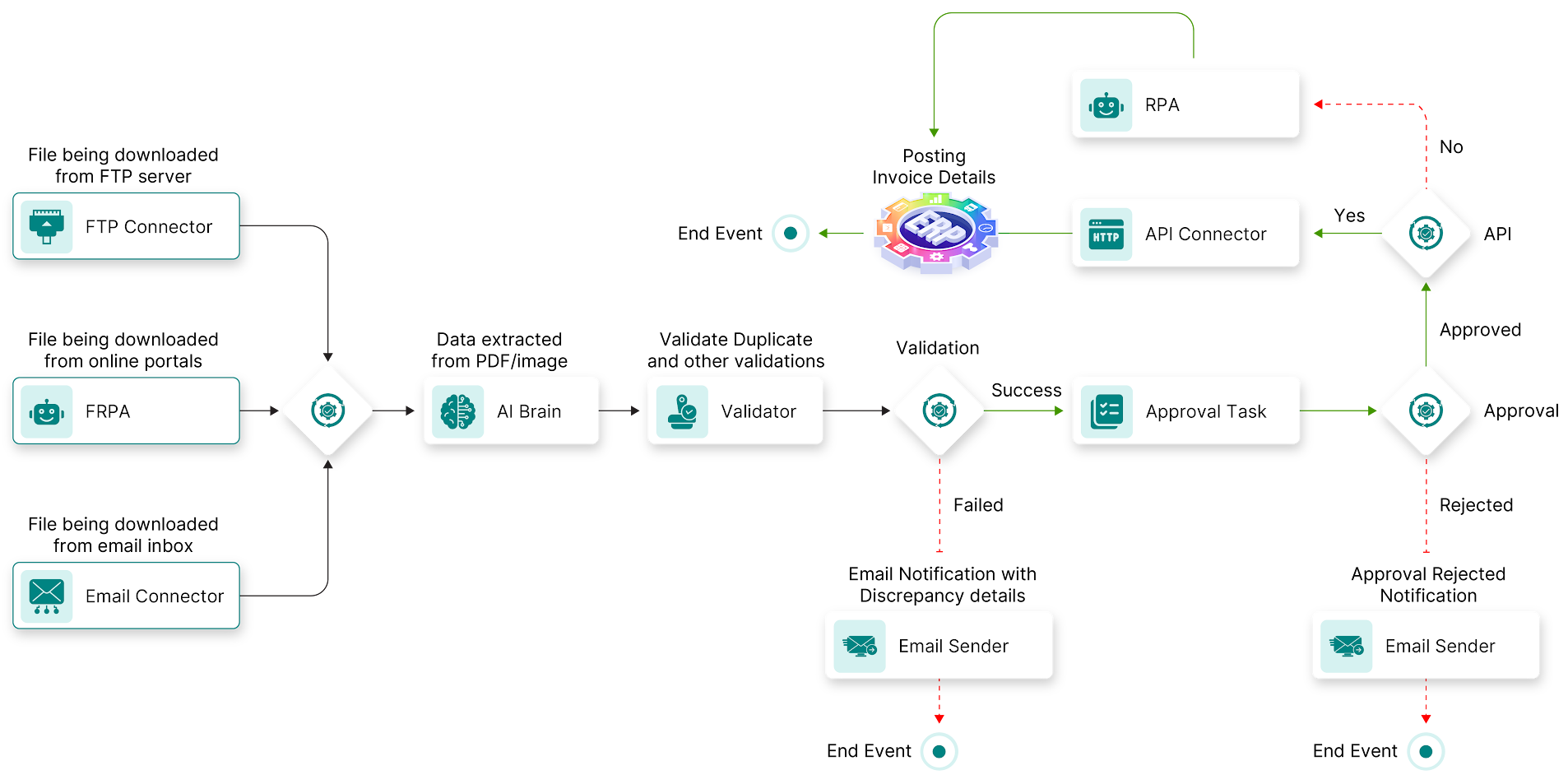
The end-to-end workflow, with people, systems and deadlines.

Read
Documents arriving by email, portal or scanner, already captured.
Execute
Bots that key in data where there is no integration.

Decide
Rules and AI that decide routine cases and escalate exceptions.
Where it is used
Use cases backed by the vendor's material
Bautomate has presentations and documented cases for each one, which we adapt to your operation.
- Accounts payable and non-trade invoices
- Purchase orders
- Inquiry to quote
- Bank and payment reconciliation
- Insurance claims via EDI
- Healthcare revenue cycle
- Mortgage loan approval workflows
- Contract review and approval
Results
What Bautomate has achieved with its clients
40%
less contract review time and 25% more accuracy at a healthcare provider in Singapore, with about SGD 150,000 saved a year.
500 hours
saved per month at a UK healthcare revenue cycle provider with more than 55 clients.
50%
faster from inquiry to quote at a solar energy company.
Bautomate cases with anonymous clients. Security: SOC 2 Type II report (security, confidentiality and availability) and ISO 27001.
What do we use it for at EXYGE?
The problems it solves in your operation
Processes that cross the ERP, legacy systems and external portals, with a lot of keying between them.
Varied documents (invoices, contracts, forms) that someone has to read and capture.
Isolated robots that break and that nobody governs.
No visibility into how much of the process is automated and where it gets stuck.
How do we implement it?
From isolated automation to an orchestrated process
01
We map the whole process
People, systems and documents, end to end, and where it makes sense to automate.
02
We design the orchestration
BPMN workflow, robots with a person in the loop, document reading and AI where it adds value.
03
We integrate
With your ERP, legacy systems and data sources, with control dashboards.
04
We measure and transfer
Automation and cycle-time indicators, and training for your team.
In which solutions?
Where does Bautomate come in?
Finance operations and shared services
Accounts payable, reconciliations and purchase orders automated end to end, with document reading.
Modern controllership, risk and compliance
Configurable business validations and traceability of every document between the ERP and the process.
Capacity and workloads
Bots that free up keying hours and dashboards that show how much of the process is already automated.
Do you have a process that crosses too many systems?
Let's talk for 30 minutes about how to orchestrate it end to end.

