Evolving its management with the Competing Values Framework
by Otto Acuña N – Managing Director – EXYGE Consulting – January 2026
Recently at our sister company, e-Consulting Global Solutions, we supported another colleague consulting company in a project with a high content of Change Management and Culture. This has motivated me to revisit in this article how much organizational culture management has changed today, where the theory and methodological content remain the same, but AI now allows exponentially greater possibilities, adding much more value than was possible just a few years ago.
Culture has become an operational lever of the first order.
For years, “measuring culture” was interpreted as an institutional snapshot: a survey, a report, a workshop, and a list of initiatives for change. Today, that approach falls short. In this article in the CEO Perspectives series, we will address organizational culture management as one of the key tools for an environment where talent rotates faster, digital transformation competes for attention with daily operations, and innovation is no longer a luxury: culture has become a first-rate operational lever. The big difference today is that we can now manage it as a data-driven system: with granularity, speed, and surgical intervention.
At EXYGE we have seen organizational culture as a topic that is not soft at all. It is a set of observable patterns and characteristics of organizations that impact decisions, priorities, coordination, learning, and execution. And if you can observe it, you can model it.
If you can model, you can intervene precisely. The good news: there is a robust and widely used theoretical basis for doing so in an orderly and comparable way. That basis is the Competing Values Framework (CVF) and its standardized measurement instrument, the Organizational Culture Assessment Instrument (OCAI).
The CVF as an “operational map” of culture
The Competing Values Framework is based on a simple reality: organizations compete with permanent tensions.
The first tension is internal versus external: internal coordination and operational stability, versus focus on the market, the customer and adaptation.
The second tension is flexibility versus control: autonomy, experimentation and agility, versus standardization, discipline and predictability.
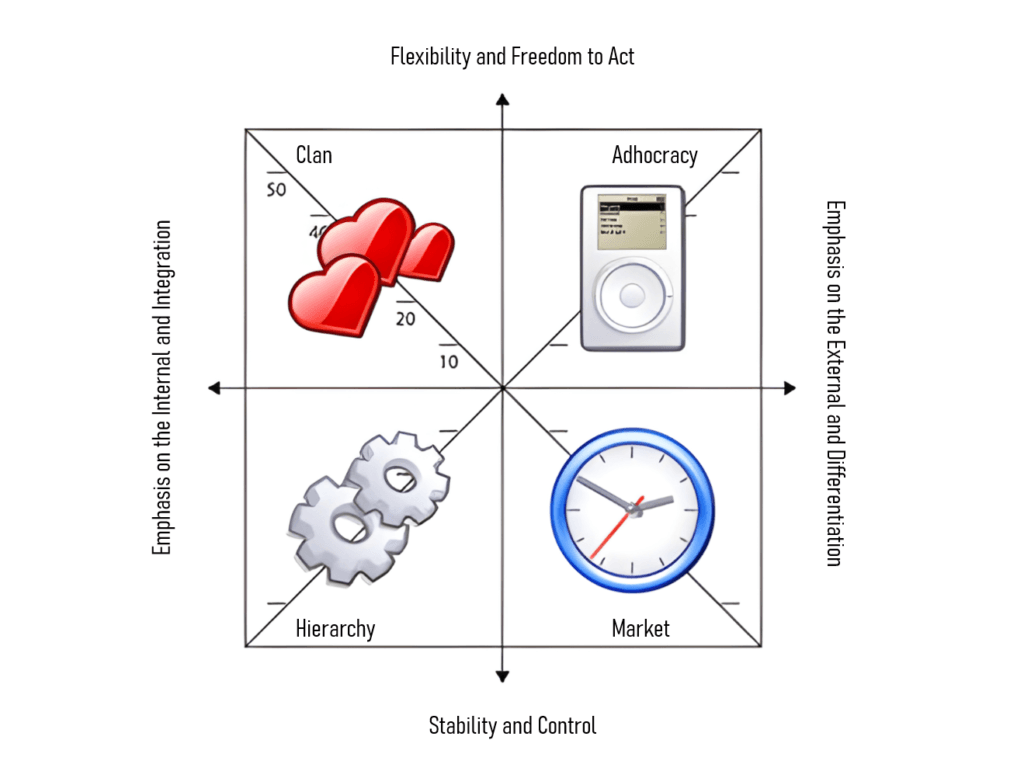
From these tensions emerge four cultural archetypes that, rather than “labels”, function as a common language for talking about real trade-offs:
- Clan: collaboration, closeness, development of people, sense of belonging.
- Adhocracy: innovation, exploration, entrepreneurship, rapid learning.
- Market: results-oriented, competitiveness, customer focus, goal fulfillment.
- Hierarchy: processes, governance, control, quality, operational continuity.
The key idea is not to “pick one” and declare victory. The key idea is to understand the current mix, the desired mix, and the kind of leadership, practices, and systems that make it possible to move the needle without destroying what already works.
From diagnostic tool to design tool
The traditional use of OCAI focuses on measuring current and preferred culture, and then activating a change plan.
That approach remains valid. But today, with the pressure to innovate and build more resilient teams, the FVC becomes something else: an organizational and team design tool.
Think of it this way: when a CEO asks for “more innovation,” many times the organization responds with initiatives, labs, or training. But if the dominant culture rewards control, punishes error, and measures performance only by plan compliance, the cultural system will neutralize the attempt.
Not because of bad intentions. For internal coherence.
The CVF allows you to turn abstract conversations into concrete decisions:
- Which behaviors are recognized and which are tolerated.
- What type of leadership is promoted and what is penalized.
- Which coordination rituals sustain the operation and which block adaptation.
- Which indicators reinforce learning and which reinforce fear.
When done right, FVC ceases to be a “culture on steroid survey.” It becomes a strategic board to align: strategy, leadership, structure, processes and capabilities.
Innovation doesn’t happen just because you have good ideas.
Innovation and culture: the connection that can no longer be ignored
In the academic literature and in multiple industry cases, a recurring pattern appears: innovation does not happen just because you have good ideas. It occurs when the environment enables ideas to become experiments, and experiments to become repeatable capabilities.
In FVC terms, that means building enough Adhocracy muscle to explore and learn. And at the same time sustain enough Hierarchy to scale what works without permanent improvisation. In addition, Clan is required for real collaboration, psychological safety, and knowledge transfer. And Market is required to land innovation in results, customer and value.
The modern question is not “what culture do we have.” The right question is: “what cultural mix do we need to execute our strategy, without breaking the operation, and without stifling innovation?” That’s the kind of question that the FVC allows you to answer with data and not intuition.
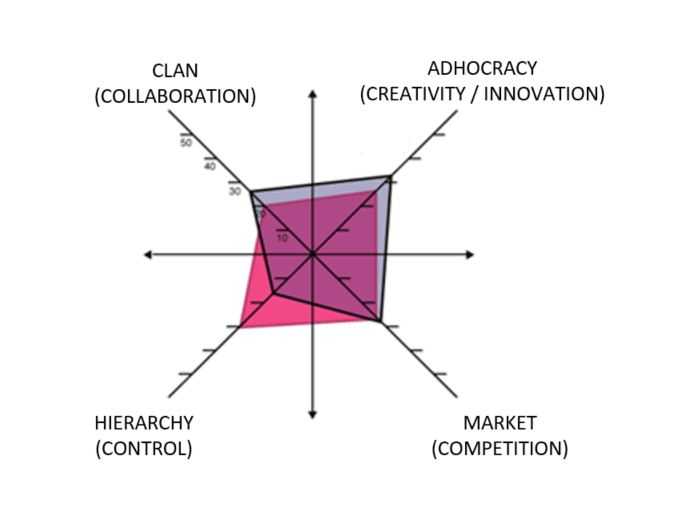
The qualitative leap: culture based on data, empowered by technology and AI.
Here is the turning point of this decade: the CVF and the OCAI did not change. What changed was the ability to collect, process, and exploit cultural data at an unprecedented scale and speed.
Previously, a cultural measurement could take weeks or months, with small samples, little segmentation, and limited analysis.
Today, organizations can collect data from tens of thousands of people in very short times, using everyday channels: SMS, email, WhatsApp, and other digital communication routes.
And most importantly, that data can be “slice & dice” virtually limitlessly, to identify sub-cultures, contrast them, and design targeted interventions.
From the perspective of HR and Transformation leaders, this is a game-changer:
- We no longer talk about “one culture” on average.
- We are talking about a living map of sub-cultures, with patterns by zone, role, unit, shift, seniority, or leadership layer.
- And each sub-culture may have a different intervention plan, with metrics and monitoring.
At EXYGE and in the e-CGS ecosystem of consulting partners, this translates into a practical capability: turning culture into actionable analytics.
– Not to produce nicer reports.
– To produce better, faster, and traceable decisions.
Two practical examples: what enables the analysis of subcultures.
1) A mass consumption company in health and beauty: culture at scale in field personnel.
Imagine a sales force and field operation distributed throughout a territory, with very different commercial realities depending on the district. The organization wanted to understand, precisely, how culture varied between zones, and how that variation impacted execution, coordination, and adoption of business practices. A customized version of the OCAI was used, massively deployed to field personnel, and the result was analyzed in almost 30 sub-cultures corresponding to commercial districts.
- The typical finding in these scenarios is not that “one area is good and another is bad.”
- The typical finding is that each subculture optimizes for its context: some privilege speed and results, others privilege control and compliance, others privilege internal cohesion.
- The real value is that the intervention ceases to be generic.

With the analysis by sub-culture, Human Resources and business leaders were able to:
- Prioritize districts with specific gaps.
- Adjust the expected leadership style by zone.
- Change coordination rituals and recognition mechanisms.
- Design support and training plans with a real focus, not a massive one.
That was difficult to do “by hand” a few years ago. Today it is completely viable.
2) A health and medical device company: service culture for the internal customer.
In organizations with internal support functions, the “customer” is not always external. Many times, the challenge is to build a culture of service to the internal user areas: commercial, operations, plant, or field force, and these support areas are critical to the competitiveness and productivity of the internal user areas.
In this case, the organization wanted to elevate the internal customer experience.
– Not just with processes and SLAs.
– Also with consistent behaviors, empathy, collaboration, and resolution orientation.
OCAI was used as a central tool to manage the shift towards a culture of service in internal support staff. The power of the FVC here is that it allows “service” to be translated into a particular cultural mix:
- Clan for closeness, collaboration and a supportive attitude.
- Market to focus on results, response times and user satisfaction.
- Hierarchy to standardize what needs to be repeatable and reliable.
- Adhocracy to resolve exceptions and continuously improve.
The conversation ceased to be moralistic, of the type “you have to have a better attitude”. It became operational: what practices, what leadership, what indicators, and what coordination mechanisms make service a natural behavior and not a heroic effort.
What modern FVC-based culture management looks like.
A modern, practical, and executive approach usually follows a route like this:
- Define what it is measured for: innovation, post-merger integration, service, agility, operational excellence, security, or growth.
- Measure with a robust and comparable instrument: OCAI as a base, with responsible personalization when the context requires it.
- Segment from the beginning: do not wait until the end to “see if you can” segment.
- Identify relevant sub-cultures: by geography, business, layer, critical role, or internal customer journey.
- Turning findings into design decisions: leadership, structure, governance, metrics, rituals, incentives.
- Intervene with precision: pilots, communities of practice, layered coaching, redesign of rituals, adjustment of performance management.
- Monitor and adjust: culture as a living system, not as a project that “closes down”.
Why the CVF and the OCAI continue to be a global reference.
There are many models of culture and climate.
Few achieve, at the same time, three things: simplicity in talking to leaders, conceptual robustness, and the ability to compare. The CVF and the OCAI stand out for this combination.
They are versatile, applicable across multiple industries and organization sizes, and structured enough to turn culture into a common language between CEO, HR, and Transformation. In the age of AI, that foundation becomes more powerful, not less.
- Theory provides the framework.
- Technology provides scale and speed.
- Analytics provide focus.
- And the intervention becomes more strategic, more punctual and more measurable.
What has changed is our ability to see it clearly, understand it in layers, and manage it as an organizational capacity.
Final Words: Culture as Measurable Competitive Advantage
Culture was always there. What has changed is our ability to see it clearly, understand it in layers, and manage it as an organizational capacity.
For CEOs, this means accelerating strategy without betting on luck. For HR, it means moving from generic programs to high-impact interventions. For transformation leaders, it means reducing friction, improving adoption, and designing teams that execute and learn. The promise of modern culture management is clear: better decisions, faster, with a common language and with evidence.
Data-driven organizational culture, empowered by technology and AI, and supported by a robust theoretical and empirical base.
Why is our approach different? We focus on the transfer of change management know-how and organizational culture.
Our projects are not only measurement diagnoses and a report with recommendations, they fundamentally seek to transfer practical knowledge and the ability to autonomously replicate the use of the Competing Values Framework and its OCAI tool.
For a tool as powerful as culture management to become an internalized capability, the external consultant cannot be part of the equation beyond queries or eventually data processing. An organizational capability is developed just like a muscle, it requires daily exercise and training, so it needs to be part of the organization’s “standard internal capability.”
That is why at EXYGE, we accompany the client in the process of discovery, understanding and use of this tool, until they achieve autonomy and do not need us – as external – to measure or use the data for a personalized intervention. Our focus is on achieving internal competence, not on the specific analysis of culture as a deliverable.

