

by Otto Acuña N – Managing Director – EXYGE Consulting – February 2026
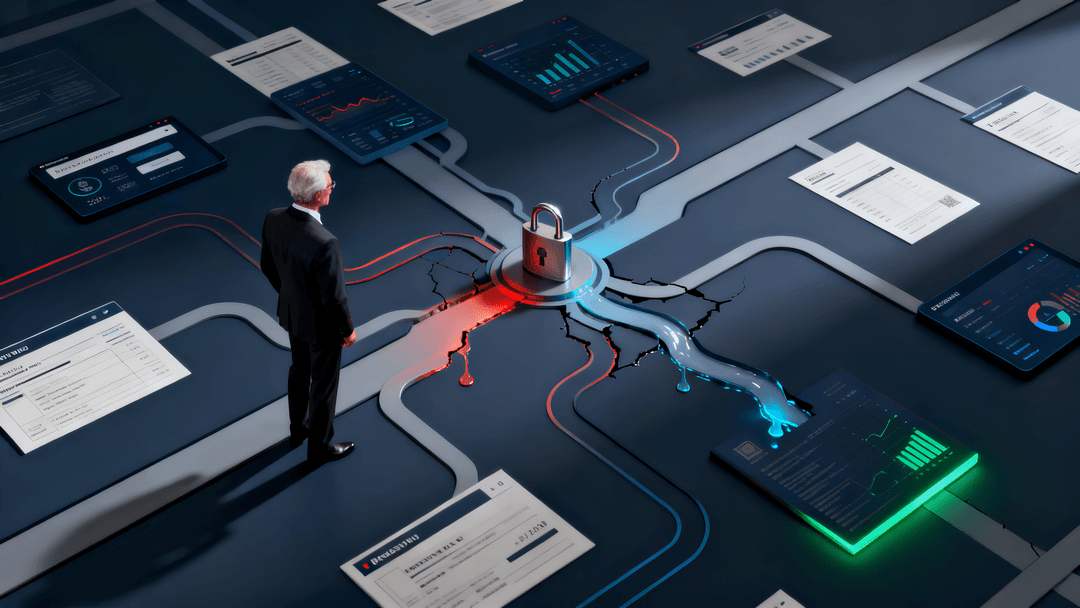
In almost any industry, there is a silent delta between what the business "sells" and what it actually "collects and retains."
This gap is usually called revenue leakage: revenue that is lost due to errors, omissions, discrepancies, delays, breaches of contract, reversals, unmanaged claims, or failures in reconciliation and control. It's not always fraud. Many times it is simply operational complexity without financial assurance mechanisms.
The silent delta in every industry between what is sold and what is actually collected and retained
From the CFO's chair, revenue leakage becomes critical for three reasons:
- First: it occurs in micro-leaks that "don't hurt" individually, but add up materially at the end of the month.
- Second: it hits directly on margin, because the fixed cost has already occurred.
- Third: it also manifests itself as a financial cost, because charging late or applying income late increases working capital and DSO (average collection period).
Types of Revenue Leakage: A Practical Map for Finance and Operations.
At the executive level, it helps to think of leakage as a set of "breaking points" in the monetization cycle.
1) Leaks due to capture and invoicing.
This happens when the service or product was delivered, but was not fully or correctly invoiced.
Examples: Missed charges, misapplied prices, out-of-policy discounts, miscalculated taxes, credit notes not issued or issued late.
2) Leaks due to collection, application of payments and reconciliation.
Here the income exists, but it is "lost" on the way between the customer and the accounting.
Examples: unidentified payments, misapplied partial payments, differences in commissions, FX, rounding, chargebacks, returns, and above all: late reconciliations that prevent claiming revenue on time.
3) Claims leaks, disputes, and appeal windows.
A lot of income is lost because the right to claim expires.
Examples: underpayments that are not detected within the contractual SLA, chargebacks that are not disputed, claims to insurers that prescribe, unsolicited adjustments.
4) Leakage due to indirect taxes, reverses and compliance.
An inconspicuous classic: paying more taxes for reversed or refunded transactions, or not recovering credits when due.
In sales or VA taxes, the damage is not only paying incorrectly: it is that correcting late costs management and can be irrecoverable in practice.
5) Leakage due to delays: leakage as a financial cost.
Even if the income does not "disappear", there is a cost to credditing it late. More DSO (this is the standard KPI for the average collection period) means more cash trapped. An additional day of DSO can represent relevant amounts of cash tied up, depending on sales and cost of capital. ("What is the cost of an extra day at the DSO?" [HighRadius])
6) Contract leakage: post-signing value erosion .
There is leakage when price clauses, penalties, indexations, minimums, or volume adjustments are not executed.
Deloitte's research mentions average erosion of contract value of 8.6%, with high dispersion between best and worst performances. ("How does contract operational excellence increase its value?" [Deloitte])
How much is "normal" to lose? Quick references by industry.
There is no single universal benchmark, but there are useful ranges to size the problem:
- Telecom: in revenue assurance practices, losses in the order of 1% to 3% per year are cited in many contexts, and there are specific estimates around 1.5% in reports from the TM Forum community. ("A Use Case for AI to Reduce Revenue Leakage" [ericsson.com])
- Healthcare (hospitals and providers): Reported to lose about 3% to 5% of net income due to inefficiencies, missed opportunities, and underpayments in the revenue cycle. ("Why AI is a promising tool for eliminating hospital revenue leakage?" [HFMA])
- Contract management (multi-sectoral): average erosion of 8.6% of the contractual value due to poor post-execution management. ("How does contract operational excellence increase its value?" [Deloitte])
And as a "macro context" in payments, which impacts multiple industries: The cost of failed payments has been estimated at USD 118.5 billion globally (fees, work and lost business) according to a study released by LexisNexis Risk Solutions through Accuity. ("Accuity Study Reveals Huge Lost Number in Payment Gateways in 2020" [LexisNexis Risk Solutions])
A huge impact of false declines has also been estimated, with figures in the hundreds of billions in lost sales, cited in Mastercard material. (PDF "5 Ways to Avoid Payment Gateway Fraud" [Mastercard])
Example 1: payment gateways and cards. The most traditional, and most underestimated, leakage.
In businesses with high transactional volume in the Revenue Cycle, the actual "Order to Cash" is a puzzle. It is not "sale equal to deposit". It is "sale equal to a set of events" that end, or not, in liquidation.
Typical leaks here include:
- Incomplete settlements for chargebacks, reverses, returns, fees, FX and withholdings.
- Payments received but not applied, or applied to the wrong invoice.
- Differences between the report of the card payment processor, mobile payments (country's phone-to-phone gateway,WeChat, Alipay+), the various banks where you have collecting bank accounts and the ERP, which are "pending" for weeks.
- Sales or value-added tax settled on an incorrect basis when there are reversals and adjustments, especially if the returns accounting is out of sync with the tax accounting.
- Financial cost of crediting card or wallet payments late on accounts receivable, raising DSO and distorting forecasted cash. ("What is the cost of an extra day at the DSO?" [HighRadius])
The pattern is always the same. If reconciliation is manual or by sampling, the business learns to tolerate small leaks. If the business tolerates small leaks, over time they become, cumulatively, an invisible budget of losses.
Example 2: Coinsurance and payments from insurers to clinics, laboratories and medical providers.
This case is perfect to explain revenue leakage "by complexity". In healthcare, income does not depend only on the patient, but on multiple payers, rules, reports and claim windows.
Typical leaks include.
- Underpayments: the insurer pays differently than the expected percentage, or applies deductibles and caps differently, and if it is not detected quickly, the opportunity to claim is lost. ("Why AI is a promising tool for eliminating hospital revenue leakage?" [HFMA])
- Aggregate payments: a transfer brings multiple invoices, and the detail comes in a remittance or EOB report, with different formats per insurer.
- Rejections and denials: if the follow-up process is slow, the denial becomes operational, even though it was "theoretically" recoverable. ("Managing the Income Cycle: Science and Art" [PMC])
- Misalignment between the clinic (operations), billing, and accounting: the service is executed, the coding changes, the claim is corrected, the payment is late, and the reconciliation does not tie.
- Exhaustion Run: When there are hundreds of small discrepancies, the team chooses battles and leaves money on the table.
In this scenario, automated reconciliation ceases to be "efficiency", it becomes critical financial control, because it protects the right to collect within deadlines and contractual evidence.
Leak Closure Strategy: A CEO and CFO approach, with automation as the backbone.
A serious revenue leakage strategy is not an isolated project. It is an assurance system that combines governance, analytics, and automation.
Step 1: Define the leak map and quantify.
Separate leakage by categories: capture, billing, collection, conciliation, disputes, taxes, contracts, and financial cost.
Then: estimate materiality with a "top 10" of leaks by value and frequency.
Step 2: Set control KPIs.
Some KPIs that do move the needle:
- Estimated leakage and recovered leakage.
- Automatic reconciliation percentage and average reconciliation time.
- Unapplied cash and differences by PSP or insurer.
- DSO, aging and write-offs due to root cause.
Step 3: Close leaks with redesign and automation of incoming money reconciliations.
Here's the key point that differentiates "intent" from "control." If your business automates reconciliations, it accomplishes three things at once:
- Total coverage: no longer dependent on sampling.
- Speed: Detects discrepancies within claim windows.
- Accounting discipline: reduces missed payments, accelerates closing and lowers DSO.
In digital payments, this means reconciling payment providers, bank, and ERP with rules, tolerances, and exception management.
In healthcare, it means reconciling remittances, aggregate payments, contracts, and invoices, with intelligence to map formats and trigger claims when there is underpayment.
Step 4: Turn account reconciliation into a "prevention engine".
The goal is not just to detect. The goal is for each discrepancy to fuel improvements in pricing, contracts, front office, coding, and charging rules.
There, revenue leakage ceases to be a back-office problem, and becomes an operational excellence business advantage.
Reflection and Call-to-Action
Revenue leakage is the invisible tax of complexity. The quickest and most controllable way to start shutting it down is to strengthen"the last mile" of money collection.
That last mile is the automation of the reconciliations of incoming money, because it converts sales into cash with evidence, speed and control.
At EXYGE, we specialize in back-office operations and this includes complementing our financial process improvement services with the ability to achieve results in that last mile. Since 2025 we have been partners of DAMAP, initially from Costa Rica, an automated financial reconciliation platform that achieves up to 93% hands-off reconciliation without manual intervention. As the video below indicates at the end, we cover the Americas, the Iberian Peninsula and the GCC region in the Middle East. If you want to know more about it, contact us by email or request a short video call to find out about it.

